
Damping Treatments
Treating some of the surfaces of an enclosure can minimise or eliminate standing waves
A standing wave occurs when sound energy is reflected between two walls,
or a wall and the driver.
If the frequency is right, the reflected sound reinforces the radiated sound, leading to a resonance.
The distance between the reflective elements equals half the wavelenth
of the resonance.
The following Animation courtesy of Dr. Dan Russell, Kettering University shows this phenomenon
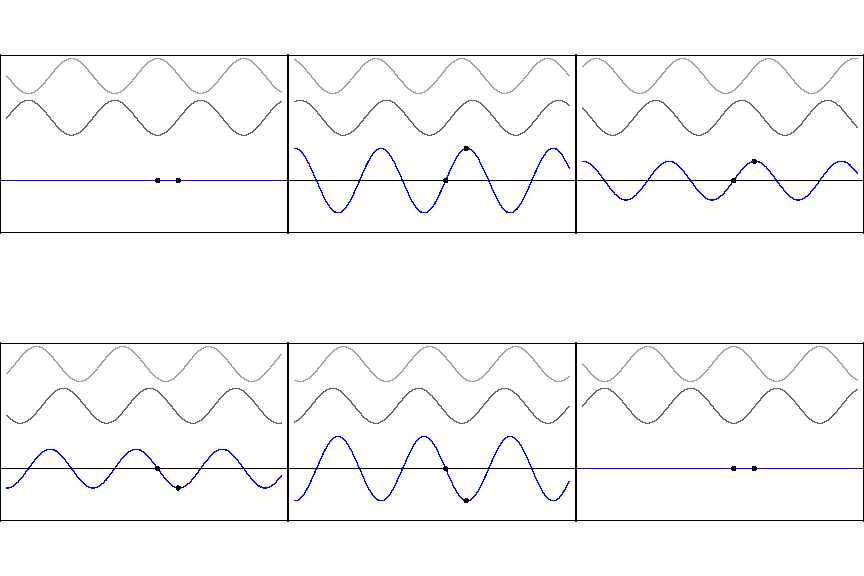
The original wave, shown at the top, adds to the reflected wave, shown in the middle. The result, shown at the bottom, is a wave that is stationary, thus known as a standing wave.
Another look at standing waves can be found at the University of Toronto
For an easy way to see what frequencies your box is vulnerable to, grab a copy of
boxnotes or sonosub from this site.
Applying the treatment
The lowest frequency standing waves in an enclosure have a
maximum velocity in the centre of the box,
but zero velocity at the walls.
They do however have a maximum variation in pressure at the walls.
Full-range speakers have acoustic wool stuffed into the box to remove energy due to friction
as the air moves through the fibres. The effectiveness of this approach diminishes as frequency is reduced.
By the time we get below 300hz, the stuffing is basically useless.
For subwoofers, stuffing will not help with the fundamental resonances, however it is still useful for treating harmonics, which may be exicted by distortion from over-driving, or by shallow rolloff slopes in your bass management system.
What can help however, is to treat the walls with something that can
convert pressure variations into movement, and
then remove energy by internal friction. For rooms, this approach is used by the
Modex commercial bass traps to good effect.
Inside subwoofers, closed-cell foam seems to work quite well in this application. It has the membrane-like property that can work the magic, and the density to consume some energy by internal friction. Buy your foam from an upholstery supplier or, in Australia, Clark Rubber.
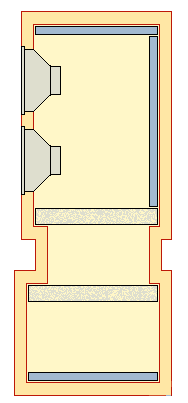
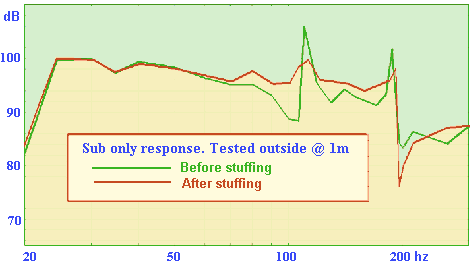
By way of example, I added closed-cell foam to the back, top and bottom walls of one of my subwoofers.
I also put acoustic wool across the centre. As you can see, the response is much smoother after the treatment.
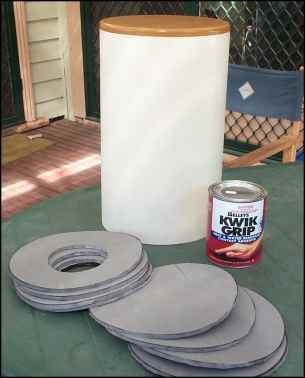
Here is a look at the closed-cell foam used to damp resonances in yet another subwoofer
Another product that has been traditionally used, and gets a good wrap, is
layers of felt a few inches thick.
I've not tried dynamat, but suspect it is more suitable for full-range speakers
Panel resonances
Panels have resonant modes across their dimensions. The larger the unsupported distance, the lower the frequency.
The first method of addressing this problem is to add bracing to the enclosure. One of the most effective is the shelf brace
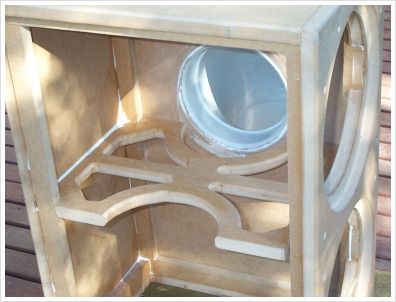
Shelf brace
There's no need to go overboard - usually one of these across the centre of the box is sufficient. If your sub is
quite tall, you could put two or three in.
The second method of addressing panel resonances is to apply sound deadening material to the panel.
An effective product for such noise reduction is bituminous foil, such as used in the Automotive industry. Jaycar in Australia sell this in sheets, as well as a cheaper plasticised version. I'm sure Parts-Express sells similar stuff in the States.
Yet another method is constrained layer damping. This is where dissimilar materials are sandwiched together into a panel. Art Ludwig has a page that looks at this technique.