
Subwoofer Porting
This section brings together information about porting derived from a series of experiments and measurements, along with techniques for making your own DIY subwoofer ports.
Advantages of a Ported Subwoofer
- A ported subwoofer will have a greater output than a sealed sub at low frequencies
- The ported design makes it possible for DIY'ers to build an affordable subwoofer that is suitable for Home Theatre usage.
Disadvantages of a Ported Subwoofer
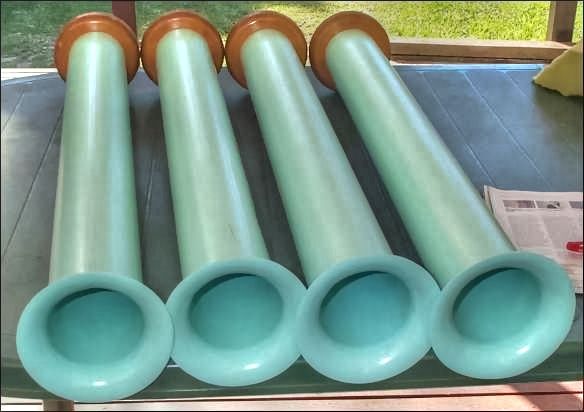
- Port Noise. If the port is too small, the air has to move through it too quickly and you WILL hear it!. The solution is to use flares to allow higher airspeeds before turbulence sets in. For an unflared port, you need to stay below 10 m/sec whereas adding a 35mm flare to an 86mm port lifts the acceptable speed @30hz from 7 m/sec to around 22 m/sec.
- Pipe mode resonance. As the port gets longer, the resonant frequency of the port decreases.
- Box Size. The ported enclosure is double the size of a sealed enclosure.
- Cone Excursion. Below the resonance of the vent, cone excursion can become an issue. If this is going to be excessive,you will need a hi-pass filter.
- Transient Response. A ported subwoofer doesn't sound quite as crisp as a sealed sub.
Relative costs
A ported subwoofer will cost more than a sealed box. Commercial flared ports and / or PVC pipe and fittings become expensive, particularly in the larger sizes as utilised in modern subs. There is also the cost in time to install and finish the ports. DIY ports, as described on this site are much cheaper but take a fair amount of time to produce. A sealed box can use high-excursion drivers with equalisation circuits and larger amplifers to match the bottom end of the ported systems, but the driver and amp costs outweigh the savings in the box itself.
Pages
- Flare testing experiments determine how big a flare is required for your subwoofer or speaker to avoid "chuffing"
- DIY Port Flares Routed, heat molded and bondo flares. Smoothing rings and donuts.
- Long port options Subwoofer enclosure too small, ports too long - what can you do?
- PVC Pipe sizes Some of the sizes available in Australia suitable for making speaker ports
- Passive radiators An alternative to ports. Sample design compared to equivalent ported enclosure