
Long Port options
Some suggestions for when the port length is greater than the box size
When a ported subwoofer is tuned low, and uses ports large enough to keep airspeed to a reasonable level, the result can be long ports. Here are a few ideas to help you deal with them.....
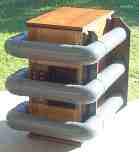
Run external ports
As shown elsewhere on this site, external ports can be employed where you are happy to have a sub that doesn't disappear into the decor. Great conversation starter!See more on the Sidewinder sub
Fold the port up inside the box
For a conventional looking sub, you can try this arrangement. Do your measurements carefully to leave room for the driver and amp. Here a shelf brace doubles as a bracket to hold the ports. This is a box with an internal height of 680mm containing a pair of 823mm ventsSee more on the Snorky sub
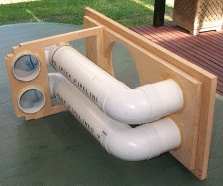
Build a concentric port
I experimented with one of these - after much construction and testing, I found that it was far too noisy. The changes in direction of the airflow and boundary effects from the increased circumference proved too much.Someone else might be able to refine the design to make it workable
See my notes
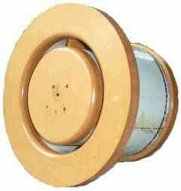
Use a Spiral port
For advanced constructors only! This is the solution adopted by Genelec, who make high output subs for commercial use. The port is made from metal sheet, and doubles as the sides of the enclosure.See more on Genelec Subs (offsite link)

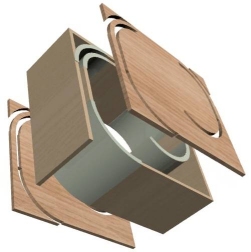
Build rectangular port into the box walls
For those of us who are less handy with metalwork, a similar solution can be done in wood. Slot ports have been around for a while in the pro-sound world and even some commercial HT subs have themSee more on Slot port flaring
Use port flares
Less turbulence means a smaller diameter port can be used - which means a shorter vent. You can use commercial flares or make your own. They really make a difference!See more on Port Flares
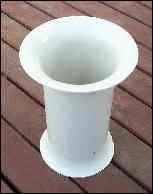
Flange both ends of your port
The "end effect" means a slightly shorter port is required. You should be doing this anyway! If you are unable to flange the port intake, consider installing a smoothing ringSee more on smoothing rings
Increase box size slightly
For a given tuning frequency, as box volume increases, the port length decreases. This option increases air velocity, so careful modelling is needed. Worth exploring if a modest saving in length saves having to use a bend in your port.
Lower tuning frequency slightly
Port airspeed varies with frequency and peaks at the tuning frequency. For borderline designs, dropping tuning a little may decrease velocity enough to allow a smaller diameter port, which will be shorterSurely with all these options you'll never get a port noise complaint ever again!