Passive Radiators
Passive Radiators can be used to create a subwoofer with a low tuning frequency in a small enclosure without having to use long ports.
A Passive Radiator (PR) is basically a driver without the magnet or coil assembly, along with a means of attaching additional mass to adjust its resonant frequency. They work by using the effective mass of the PR to replace the mass of air that would be contained within a port of the same tuning frequency. To prevent over-excursion of the passive radiator, it is recommended that you have twice the displacement of the main driver. For example a 10 inch driver would require a pair of 10 inch PRs with the same excursion, or a 12 incher with higher excursion. At the resonant frequency of the PR there is a dip in output of the subwoofer. Below resonance, the output drops more quickly than a ported system and the driver becomes unloaded.
Advantages of a passive radiator design
- Low tuning can be achieved in a small box
- No port noise
Disadvantages of a passive radiator design
- Transient response below tuning point is worse than a ported box
- Faster rolloff may require a high-pass filter that an equivalent ported system might just scrape by without.
- Cost - a PR is more expensive than a flared port
Example design
This example uses a pair of PRs in a design that's equivalent to the Snorky subwoofer.
Since PR designs roll off quicker than ported, a lower tune design is also examined.
The amp is the 80W Jaycar AMP with 4dB boost @ 35hz and the box volume is 50 litres.
Tuning frequency is 28 hz for the Snorky design and the first PR design. The second PR design is tuned to 25.6 hz
When entering the PR details into WinISD, use the T/S parameters from the normal driver.
You will need to enter Vas Qms Fs Sd and Xmax - none of which are altered by removing the magnet.
You also enter the number of PRs and the mass added to each cone. As you change the mass,
you can see the change in the response.
The "Snorky" design is shown in blue, the Passive Radiator design is shown in red
and the Lower tune PR design is shown in green
Output (SPL)
The PR designs fall away quickly below the tuning frequency. Above that, the designs are about the same. Notice the notches at 18hz and 17hz, which are the resonant frequencies of the PRs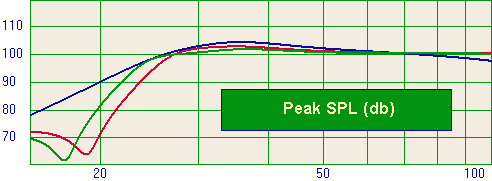
Cone excursion - Driver
All designs keep excursion below Xmax + 10%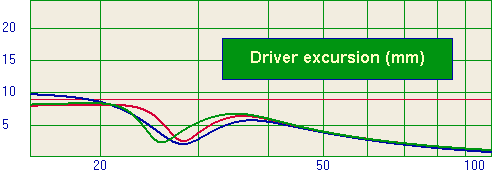
Cone Excursion - Passive Radiator
Excursion is below Xmax + 10%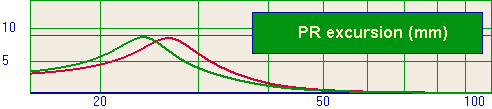
Air Velocity of Port
The snorky design has a pair of 86mm ports, 824mm long. Peak velocity is around 10 m/sec. According to Flare-it, a flare of 25mm radius is needed to be noise free.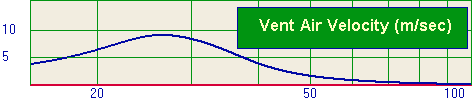
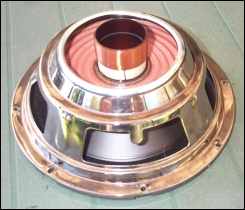
I have a few drivers that have been cooked and plan to convert them into PRs. The magnet assembly can be cut off and the edge of the basket cleaned up
by adding some silver plastic automotive door trim. An MDF disk can be epoxied into the voice coil former, with a bolt through the disk allowing weights to be added.
Some box variations
The typical PR sub is a cube, with the driver facing forward and a pair of PRs on opposing sides, cancelling out any excess vibration.
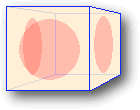
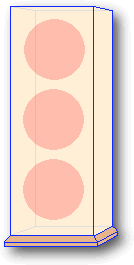
All three units could be mounted facing forward which, with the cones all the same, would give the appearance of a tripple driver design. To counter any tendency for the enclosure to walk, it could be built a little on the heavy side and have a plinth added for extra stability