
WinISD Case study
Here is a short study on using WinISD to find the best design where size and cost dictate a less than optimum enclosure size
Someone saw my original Beer Fridge subwoofer at a mate's place and was interested in getting one made. He was happy with the output, but wanted a smaller unit.
Luckily, using the Jaycar CS-2274 driver gives some significant advantages over the driver used in the original
- The driver has a lower Vas than the one used in the beer fridge
- It also has a larger available excursion
- The client doesn't require the full output this driver
Although this driver can handle 125w, sticking with the 80w amp with it's 4db boost @ 35hz will allow us to do without an add-on hi-pass filter, saving about $200 and 2 days labour
Four different cases were investigated to see what compromises could be made
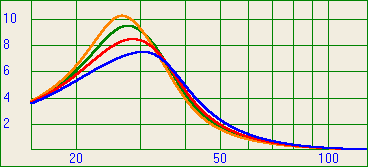
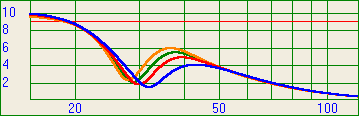
The following graphs show the changes as box volume is lowered and tuning adjusted
SPL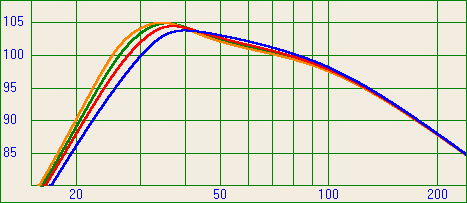
47 litre 28hz tuning
40 litre 30hz tuning
30 litre 32hz tuning
(note the spread at 30hz)
Vent air velocity
Cone excursion
Final design
Selecting a working volume of 47l and ports tuned to 28hz gives an almost identical curve to the original 90l speaker, with a peak output of 105db as shown in this WinISD simulation
SPL
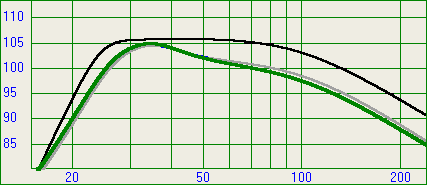
Case study 80w no filter
Original Beer Fridge
Optimum with 125w & Filter (Sidewinder)
Two 86mm ports keep the air velocity below 10m/sec, with a port length of 823mm, which can be accommodated using some bends
Using Boxnotes to calculate dimensions and resonances gives the following info:
The ports will occupy an additional 10 litres. Adding 4 litres for the driver, amp and bracing, gives a total box volume of 61 litres.
Settling on a 700mm height to match floorstanding mains, and keeping the width to 300mm, boxnotes informs me that for 19mm MDF, the depth will be 400mm
The Port resonance will be at 208hz and an enclosure top-to-bottom standing wave at 259hz

With these resonances well above the Dolby LFE cutoff of 120hz, this alignment should work well for home theater