
Concentric Port Equations
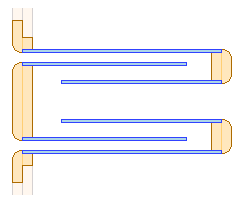
The simple equations
This section derives concentric vent equations that have been simplified by neglecting wall thickness, resulting in an error of approximately 2% or less. This is within the margin that will be encountered when trying to build a port using the range of pipe that is available from plumbing suppliers. These equations are most useful for doing a quick esimate of the sizes involved. When it comes to actual construction, use the full equations
Calculating tube diameters
Keeping the area presented to the airflow constant, the middle tube must contain the smallest tube plus the same area again
Thus the middle tube has twice the area of the smallest tube
Thus the diameter of the middle tube is sqr(2) times that of the smallest
Diameter of middle tube = sqr(2) * diameter of smallest tube
The biggest tube must contain the middle tube plus the area of the small one again
Thus the biggest tube has three times the area of the smallest tube
Thus the diameter of the biggest tube is sqr(3) times that of the smallest
Diameter of biggest tube = sqr(3) * diameter of smallest tube
Calculating end gaps
Assume for a moment that you have an inner tube with a hole as shown
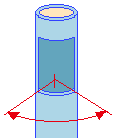
The area of the hole will be the length of the arc segment times the height of the hole
If we increase the arc segment to encompass the entire circumference of the tube,
we will define the area presented to the air as it flows around the end of the tube.
This area must equal the CSA of our small tube.
CSA=circumference_sml_tube * end-gap_sml_tube
rearranging terms
end-gap_sml_tube=CSA / circumference_sml_tube
substituting for CSA
end-gap_sml_tube=( pi * (dia_sml_tube/ 2) ^ 2 ) / ( pi* dia_sml_tube)
simplifying terms
End gap of small tube = diameter of small tube / 4
The end-gap on the middle tube will be smaller because it has a larger circumference
CSA=circumference_middle_tube * end-gap_middle_tube
rearranging terms
end-gap_middle_tube=CSA / circumference_middle_tube
substituting for CSA
end-gap_middle_tube=( pi * (dia_sml_tube/ 2)^2 ) / ( pi* dia_med_tube)
simplifying terms
end-gap_med_tube=(dia_sml_tube ^ 2 ) / ( 4 * dia_med_tube)
substituting for tube2
end-gap_med_tube=(dia_sml_tube^ 2 ) / ( 4 *dia_sml_ tube * sqr(2))
simplifying
End gap of middle tube = diameter of small tube * sqr(2) / 8
The full equations
Conventions
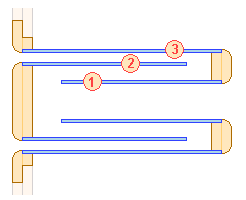
ID_tube1 is inside dia. of smallest tube
OD_tube1 is outside dia. of smallest tube
ID_tube2 is inside dia. of middle tube
OD_tube2 is outside dia. of middle tube
ID_tube3 is inside dia. of biggest tube
OD_tube3 is outside dia. of biggest tube
CSA is the Cross-sectional area presented to the airflow. Ideally constant throughout the device
Calculating tube diameters
To keep the area presented to the airflow constant...
area inside middle tube - area occupied by smallest tube = area inside smallest tube
pi * (ID_tube2 / 2)^2 - pi * (OD_tube1 / 2)^2 =pi * (ID_tube1 / 2)^2
multiplying both sides by 4/pi
ID_tube2^2 - OD_tube1 ^2 =ID_tube1)^2
rearranging terms
ID_tube2^2 =ID_tube1^2 + OD_tube1^2
taking square root of both sides
Inside diameter of middle tube = sqr(ID_tube1^2 + OD_tube1^2 )
Area inside biggest tube - area occupied by middle tube = area inside smallest tube
pi * (ID_tube3 / 2)^2 - pi * (OD_tube2 / 2)^2 =pi * (ID_tube1 / 2)^2
multiplying both sides by 4/pi
ID_tube3 ^2 -OD_tube2 ^2 = ID_tube1 ^2
rearranging terms
ID_tube3 ^2 = ID_tube1 ^2 + OD_tube2 ^2
taking square root of both sides
Inside diameter of biggest tube = sqr(ID_tube1 ^2 + OD_tube2^2)
Calculating end gaps
Once again, assume for a moment that you have an inner tube with a hole as shown. Same picture, more detailed maths.
The area of the hole will be the length of the arc segment times the height of the hole
If we increase the arc segment to encompass the entire circumference of the tube,
we will define the area presented to the air as it flows around the end of the tube.
This area must equal the CSA of our small tube.
Firstly, the end gap of the small tube
CSA=circumference_small_tube * endgap_small_tube
re-arranging terms
endgap_small_tube = CSA / circumference_small_tube
substituting for CSA
endgap_small_tube=( pi * (ID_tube1 / 2 ) ^ 2 ) / circumference_small_tube
For strict accuracy, we need to use the average circumference
endgap_small_tube=( pi * (ID_tube1 / 2 ) ^ 2 ) / ( pi*( ID_tube1 + OD_tube1)/2)
simplifying
endgap_small_tube= ( ID_tube1 ^ 2 ) / ( 2 * ( ID_tube1 + OD_tube1))
Second, the end gap of the middle tube
CSA=circumference_tube2 * endgap_tube2
endgap_tube2=CSA/average circumference_tube2
endgap_tube2=( pi * (ID_tube1 / 2)^2 ) / ( pi * (ID_ tube2 + OD_tube2) / 2)
endgap_tube2= (ID_tube1 ^ 2 ) / ( 2* (ID_ tube2 + OD_tube2))
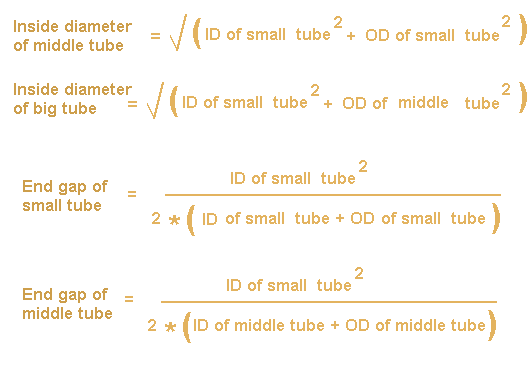
As a reality check, if you set ID = OD, these equations reduce to those in the simple proofs
If one was insane enough to construct a 5 tube port, similar reasoning would give:
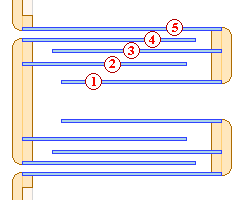
Inside diameter of tube2 = sqr(ID_tube1^2 + OD_tube1 ^2)
Inside diameter of tube3 = sqr(ID_tube1 ^2 + OD_tube2 ^2)
Inside diameter of tube4 = sqr(ID_tube1 ^2 + OD_tube3 ^2)
Inside diameter of tube5 = sqr(ID_tube1 ^2 + OD_tube4 ^2)
endgap_tube1 = (ID_tube1 ^ 2 ) / ( 2 * (ID_tube1 + OD_tube1))
endgap_tube2 = (ID_tube1 ^ 2 ) / ( 2* (ID_ tube2 + OD_tube2))
endgap_tube3 = (ID_tube1 ^ 2 ) / ( 2* (ID_ tube3 + OD_tube3))
endgap_tube4 = (ID_tube1 ^ 2 ) / ( 2* (ID_ tube4 + OD_tube4))
Acoustic length
Conventions
ID_tube1 is inside dia. of smallest tube
OD_tube1 is outside dia. of smallest tube
ID_tube2 is inside dia. of middle tube
OD_tube2 is outside dia. Of middle tube
ID_tube3 is inside dia. Of biggest tube
OD_tube3 is outside dia. Of biggest tube
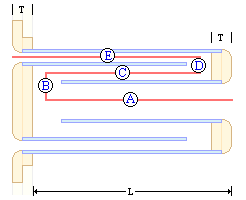
L is the physical length of the port
T is the thickness of the endcaps
Breaking the path into segments for ease of computation ...
Acoustic length = A + B + C + D + E
A = L - end_gap_tube1 / 2
B = ( ID_tube2 - OD_tube1 ) / 4 + ( OD_tube1 ) / 2
C = L - end_gap_tube1 / 2- end_gap_tube2 / 2 - T
D = ( ID_tube3 - OD_tube1 ) / 4
E = T + L - end_gap_tube2 / 2 - T
The effective acoustic length is the sum of these figures
It gets even more complicated if we go to a 5 tube port..
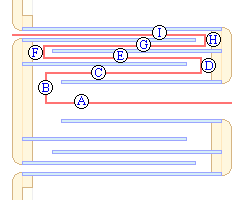
Acoustic length = A + B + C + D + E + F + G + H + I
the same as before for A to D
A = L - end_gap_tube1 / 2
B = ( ID_tube2 - OD_tube1 ) / 4 + ( OD_tube1 ) / 2
C = L - end_gap_tube1 / 2- end_gap_tube2 / 2 - T
D = ( ID_tube3 - OD_tube1 ) / 4
Segment E is different this time
E = L - end_gap_tube3 / 2- end_gap_tube2 / 2 - T
now add F through to I
F = ( ID_tube4 - OD_tube2 ) / 4
G = L - end_gap_tube4 / 2- end_gap_tube3 / 2 - T
H = ( ID_tube5 - OD_tube3 ) / 4
I = L - end_gap_tube4 / 2- T
The effective acoustic length is the sum of these figures
Composite tube
This section looks at one way of making a port tube to whatever diameter you need.
Select some PVC pipe that is the next size up from what is required
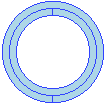
If we cut a piece lengthwise from the tube, we can then squeeze whats left to form a smaller tube.
All that remains is how to get it to stay that size. A second tube with slightly less taken out of it
could be placed around our first tube and the whole arrangement glued with a suitable glue to give us a composite tube.
It would look like this in cross-section....
Calculating how much to cut out
Let the following abbreviations apply
id_start = Inside diameter of a new unmodified tube
id_required = Inside diameter of composite tube we end up with
wall_thick = Wall thickness of a single new unmodified tube
remove_inner = Width of section removed from inner tube
remove_outer = Width of section removed from outer tube
Consider just the inner tube, and for the moment, ignore the wall thickness
This theoretical tube will have a diameter equal to the inside diameter of our starting tube
The amount to be removed is the starting circumference minus the circumference after cutting and joining
change in circumference = pi * id_start - pi * id_required
change in circumference = pi * (id_start - id_required )
Because we will be marking our cut on the outside of each tube, we will need to to know the width of the strip at that position.
This means we now need to consider the effect of wall thickness. This drawing shows the wedge that is to be removed.
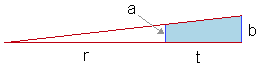
r = radius ( which is circumference / 2 )
t = wall thickness
a = reduction in inside circumference ( just calculated above )
b = reduction in outside circumference ( what we need to know )
The theory of similar triangles tells us that:
a / r = b / ( r + t )
re-arranging terms
b = a * ( r + t ) / r
substituting for known terms
remove_inner = pi * (id_start - id_required ) * ( ( id_start / 2 ) + wall_thick ) / ( id_start / 2 )
The second tube, which will become the outer layer, has the same id_start, but id_required will be larger by twice the wall thickness.
remove_outer = pi * (id_start - ( id_required + ( wall_thick * 2 ) ) ) * ( ( id_start / 2 ) + wall_thick ) / ( id_start / 2 )
Alternatively, you can make a pipe larger by inserting a strip. Use the same equations and you will get a
negative result for the "remove" figure - this is the width of the strip to be inserted.
In this situation you will lose the width of the saw cut from your initial tube. This needs to be added to the width of the strip to be inserted
Some suggested pipe sizes
These examples show the closest you could get with PVC Pipe sizes in Australia.
The middle column shows the required figures as per the full equations, using the calculator.
The right column shows what PVC pipe could be used
The slight mismatches in CSA may or may not be audible - only an experiment will tell.
Example1
| Inner tube diameter | 51 | use 50mm sewer ID-51 wall=2.2 |
| Middle tube diameter | 75 | use 75mm stormwater ID-71.8 wall=1.6 |
| Outer tube diameter | 94 | roll your own |
| Inner tube end gap | 12 | |
| Middle tube end gap | 8 |
Example2
| Inner tube diameter | 104 | use 100mm sewer ID-103 wall=3.5 |
| Middle tube diameter | 151 | use 150mm sewer ID-152 wall=4 |
| Outer tube diameter | 190 | roll your own |
| Inner tube end gap | 25 | |
| Middle tube end gap | 17 |
Example3 - Five-layer port
Adjusting thickness of tube3 to be 8mm causes layer4 to become an available size
| Inner tube diameter | 104 | use 100mm sewer ID-103 wall=3.5 |
| Tube2 diameter | 151 | use 150mm sewer ID-152 wall=4 |
| Tube3 diameter | 190 | roll your own .. wall=8mm |
| Tube4 diameter | 231 | use 225mm stormwater ID-230 wall=5 |
| Tube5 diameter | 263 | roll your own |
| Tube1 end gap | 25 | |
| Tube2 end gap | 17 | |
| Tube3 end gap | 14 | |
| Tube4 end gap | 11 |