Infinite Baffle Subwoofer
I hadn't done any designs for the Venoms because the low Xmax and high-ish Vas didn't augur well for my preferred EBS ported designs. It was then that I looked at doing up some IB designs using 4, 8 or 12 of these drivers.
Room EQ Wizard was used to choose the best location for the manifolds, with the manifold design being a result of advice from The Cult of the Infinitely Baffled
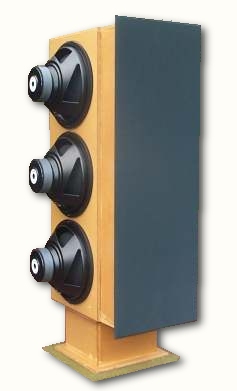
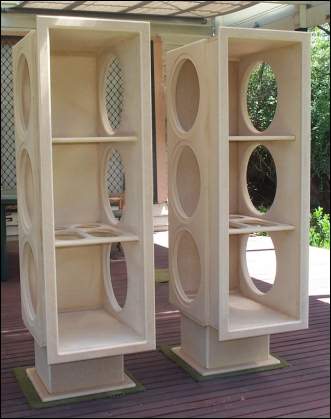
Having awoken my inner bass monster, I felt that I had no choice but to build the twelve driver design. A pair of six-driver manifolds have been built and installed giving around 22 litres displacement. A Behringer EP2500 amp is used to power this bit of extravagance.
Some of the ideas used are:
- This design gives an opening area roughly equal to the combined Sd of the drivers meaning no potential problems with compression or bandpass effects creeping into the picture
- The sound arrives from all drivers simultaneously, avoiding the dip in response that can occur with "tunnel" type manifolds
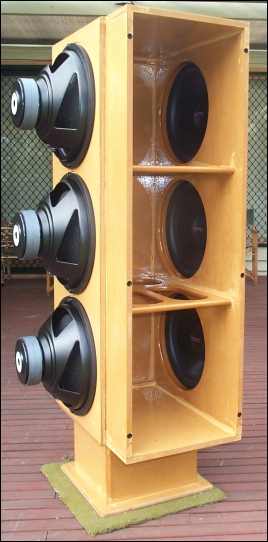
- Opposing the drivers, and using bracing between the drivers should give some cancellation in vibration
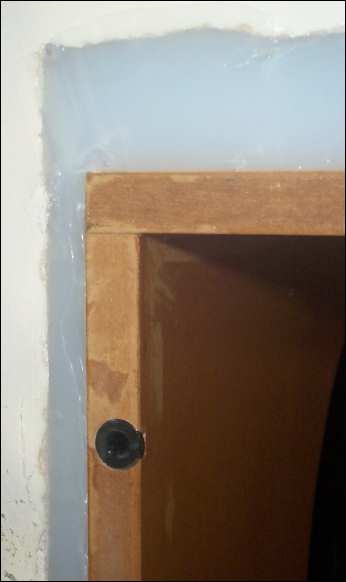
- Each manifold sits on a plinth which takes all the weight, allowing a floating design whereby the manifold is isolated from the wall opening by 5 -10mm of silicone sealant. This will further cut down on transmission of vibration to the house framing
I'm glad I didn't try to fit these into the ceiling - Each manifold with drivers weighs 75kg (165lbs)
WinISD predictions
SPL
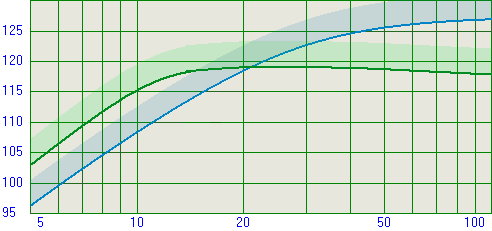
- The blue solid line is for when excursion is kept to 12.5mm
- The blue shaded area is for when excursion is allowed out to 20mm, which is the suggested Xlim. It's the zone where cone breakup leads to distortion, and thus represents 4dB of emergency headroom rather than a normal operating region.
- The green lines show what can be expected after room gain is added and some cuts are made to the higher frequencies
Excursion
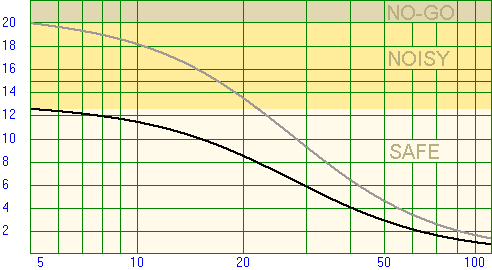
- The black line is the resulting excursion with 670w applied
- The grey line is the resulting excursion 1700w applied
Here is the response at the current seating position using the EP2500 amp
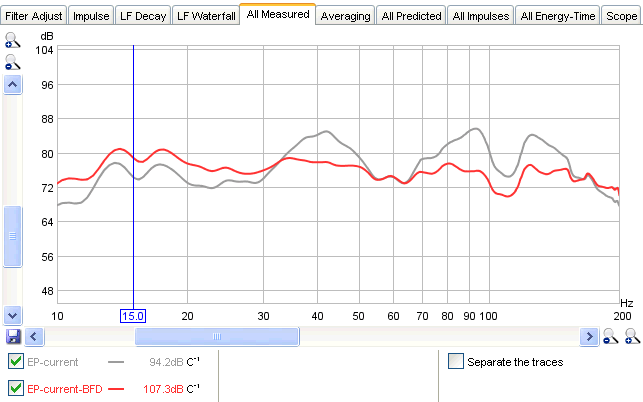
- The grey curve is with the amp only
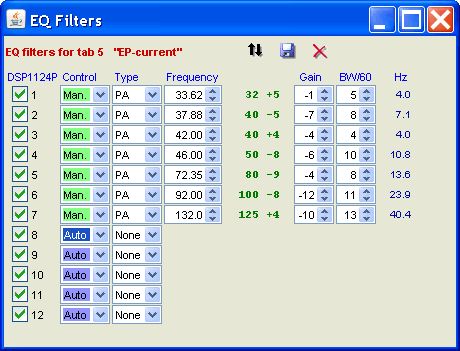
- The red curve is with a Behringer Feedback Destroyer (BFD) applying seven filters
Connection and Calibration
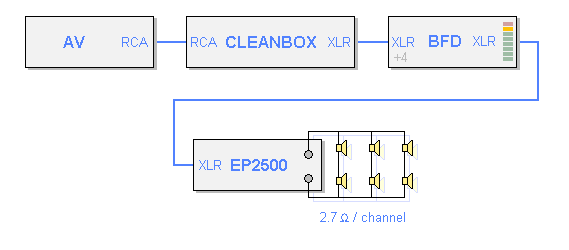
- A short RCA cable connects the AV reciever to the ART Cleanbox.
The Cleanbox can boost the signal if needed and also handles the RCA to XLR conversion. It does need a small mod to be used with subwoofers. See full details on the Cleanbox page. - An XLR cable connects the Cleanbox to the BFD. The BFD can work with either a -10dB setting or a +4dB setting - Note that this does not change the output level.
The BFD has a bar graph showing input / output level, including yellow warning and red clipping indicators. - The long run to the EP2500 in the "engine" room, is handled by a balanced XLR cable to cut down on induced noise.
- A nice feature of the EP2500 is that you can parallel the inputs using a DIP switch, saving a Y-connection and additional input plug.
Infinite Baffle Gallery
Finished sanding
These look so good it's a shame to hide them in a wall
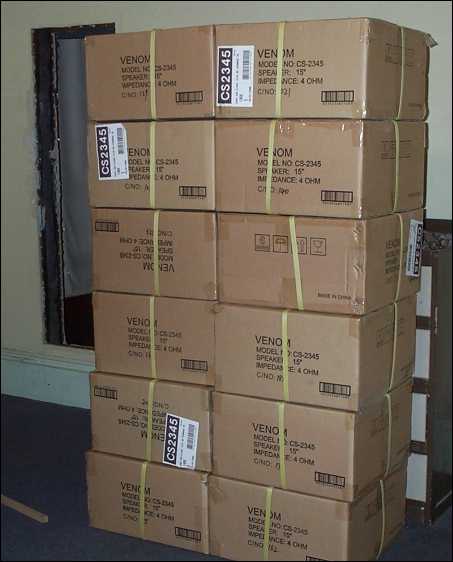
Drivers arrive
Twelve 15inch Venoms.
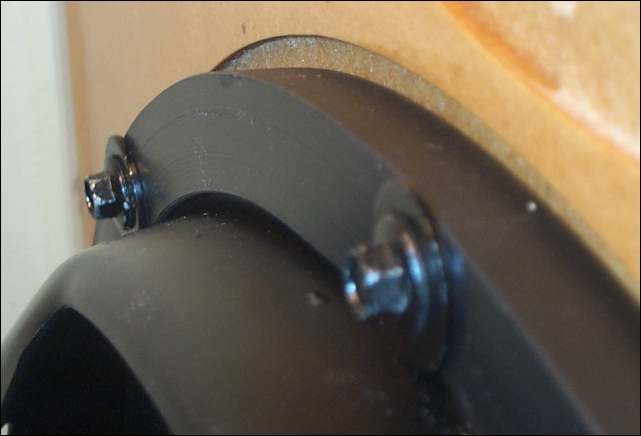
Mounting detail
The Venom driver comes with a removable rubber gasket that slips over the driver lip. Adding washers to the mounting screws allows a firm mount without overly crushing the gasket. This shot was taken after the initial tightening with a cordless drill which had a safe setting on the clutch. A cardboard template was made up to mark where to drill the screw holes. The small rebate makes locating the template easier, as well as holding the driver roughly inplace during install.
Ready to install
One of the two manifolds
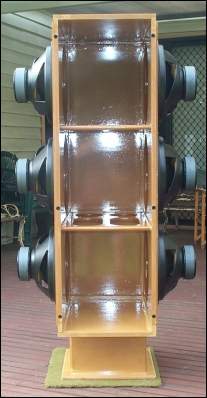
Front view
There's a fair bit of weight per side....
Manifold 33 kg
Drivers 42 kg
Plinth 8 kg
Grille 2 kg
Total 85 kg or 187 lbs
Rear view of installation
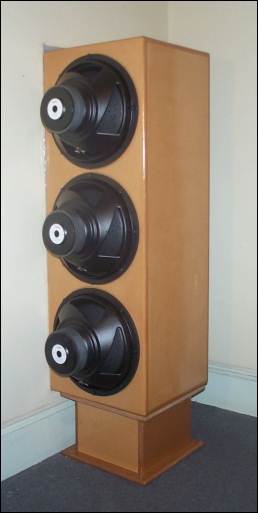
Silicone
Silicone was used to seal and isolate the manifold from the house framing. A spatula was used to get a smooth finish. Sealing two manifolds on both sides of the wall took 10 tubes.
The bottom brace was cut to allow the mains to site inside the subs.
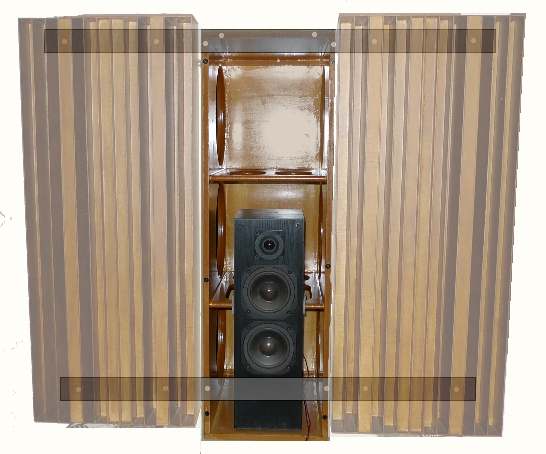
Final setup
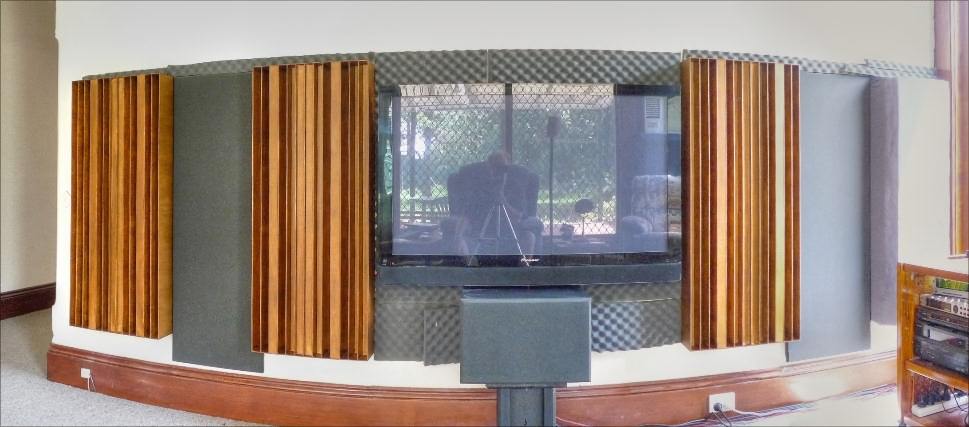
QRD Diffusers mounted next to the manifolds.