
Minimising Hum
This article looks minimising hum due to earth loops in the typical home audio setup
It details how to break the earth loop by modifying some of your RCA cables, and at how to identify where your system requires this intervention
Unbalanced connections
Most consumer level audio gear is hooked together using unbalanced cabling which comprises
an inner core carrying one leg of the signal, and an outer sheath which carries the return leg
of the signal as well as providing a shield against electric fields.
This cable is usually fitted with RCA type connectors.
The outer sheath connects to the signal ground inside each piece of equipment.
For items such as pre-amps and active filters, the signal ground on the input is "passed through"
and connected to the signal ground on the output.
This article only deals with unbalanced cabling. For help on problems with balanced cabling,
see the references at the end of this page
Earthed vs Double Insulated Equipment
If you are not sure how to classify a piece of equipment, use a multimeter or continuity tester
(battery plus lightbulb) to check if the cable sheath is connected to the earth pin on the power plug
- not plugged in of course!
Many modern devices are Double Insulated where there is no connection to the household earth.
These devices have a symbol indicating that they are double insulated, and often (but not always)
come with a power cable that only has two pins.
The purpose of this is to make sure that in the event of a failure of the mains level circuitry within the box, any lethal voltage is shunted to earth, thus blowing the fuse rather than you!
You must never disconnect the earth on such equipment.
Doing so would remove this safety feature and could result in someone's death.
From an audio perspective, earthed equipment will provide a connection between the cable shield and household earth.
If there is a second item of earthed equipment in your setup, there can be a second audio path
between your gear which will produce hum.
If you have a hum problem, and only have one item that is earthed, then the problem is not
due to an earth loop, and you need to look at other causes.
Simple Earth Loop
Consider the following drawing of two pieces of equipment, both earthed.
The signal wire is shown in red and the signal return via the sheath is shown in blue.
Note that the sheath is connected to the chassis, which in turn, is connected to the household earth.
The green loop indicates that a current can be induced in the closed earth loop.
Because this current flows in part of the audio circuit ( the sheath ), it is audible and becomes the
demon known as hum
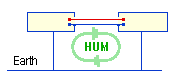
Simple earth loop
To stop the hum, we must break the loop. For safety reasons we can't break the connection between the chassis and household earth. Nor can we break the household earth connection between the two pieces of equipment. This just leaves the sheath between the two pieces of gear. Of course, there are several ways to do it:
- Use optical fibre interconnects - outside the scope of this article
- Switch to balanced cabling - buy new gear or convert selected runs using a Cleanbox
- Use isolating transformers - some possible signal loss
- Disconnect one end of the shield
Open shield approach
By disconnecting one end of the shield, the ground loop is opened and the hum disappears.
The signal return will be via the earth path linking the two pieces of equipment.
Mark your new cable with a tag so it doesn't get mixed up with normal cables.
The solution is still applicable where some items are double insulated and two or more items are earthed.
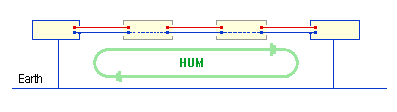
The next drawing shows two new items items of double insulated equipment inserted into the signal path.
The sheaths are shown passed through the added equipment, allowing the loop to occur even though
the equipment itself is not earthed. The chassis are shown in grey indicating that they aren't connected to the signal earth
Earth loop passing through non-earthed equipment
Disconnect the shield where a cable ENTERS an earthed device AND there is another earthed device earlier in the chain.
Using such a scheme would lead to the following solution for what could have been a real nightmare:
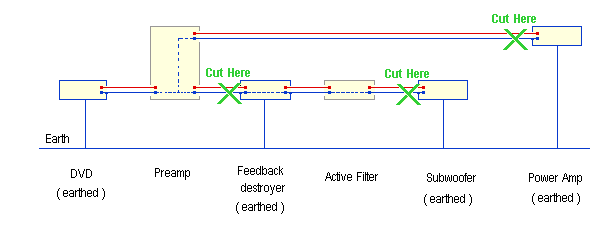
Multiple Earth loops
The next drawing shows the above diagram rearranged to show only how each piece of equipment receives its signal earth.
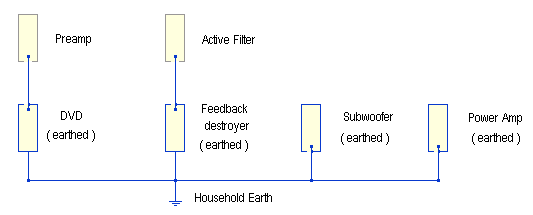
Star Earth connection
As you can see, the changes lead to a Star earth arrangement
in which no earth loops can occur.
Obviously such a complicated situation requires some planning.
Identify each piece of gear as "earthed" or "double insulated" and do a drawing showing all the signal
cables in the system. Then apply the rule to determine where you need your new cables.
If you accidentally put one of these modified cables in the wrong place, the worst that will
happen is that the signal won't get through.
Isolating transformers
If you don't like the idea of modifying cables, you can use isolating transformers. You still need to do the planning, because to cut the hum you need to put them into exactly the same spots
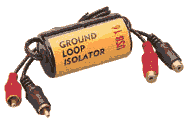
Isolating transformer
The advantage of using isolators is that if you choose the wrong spot to put them, the system will still work, although the hum will still be there. Also, as we see later in this article, removal of a piece of equipment that supplies earth for other components of the system, does not result in loss of signal path for those components. The disadvantage is they cost money and impedance mismatches may effect your signal.
Do a search on the net for ground loop isolator
- they seem to vary a fair bit in price but the cheaper ones are quite affordable.
You will normally need to buy one less than the total number of earthed devices in your system
As a final challenge, what do you do when you have multiple inputs from earthed devices?
Taking the input section from our previous drawing and adding some more earthed sources, we get:
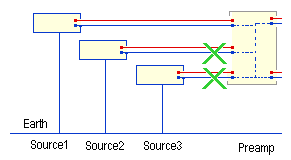
Multiple earthed inputs
As before, do your drawing. Start with the topmost input (source1) - it is earthed but it is going to a device
that is not earthed, so the rule says leave the sheath intact.
The second input comes from an earthed device, but is it going to an earthed device or not?
This is where it gets a little tricky!
The first input has effectively earthed the shields of all the connectors on the preamp.
This means that even though the preamp is double-insulated, it is now to be
treated as an earthed device.
So according to our rule the second input needs to have its shield opened. The same applies to source3.
This drawing is also perfect to illustrate one of the drawbacks with the "open shield" scheme
What happens if the component providing the earth is removed?
If source1 is taken away, it removes the signal return for all devices entering or leaving the preamp,
effectively orphaning it. In other words, the whole system stops working.
To use this technique you must view your system as an integrated unit.
If you wish to guard against this, (for example setting up a system for a friend),
you could use isolating transformers
at the positions where the analysis says to open the shield.
With such an arrangement, removal of source1 no longer prevents the rest of the system from working.
What would happen is that the shields on the "preamp-to-poweramp" and "preamp-to-feedbackdestroyer" runs
would no longer be earthed. This would probably introduce some hum back into the system.
Think of them as a buffer to offset future change, rather than a cure forever.
Consulting your drawing (you did keep it didn't you?), you see that the logical way to derive
a new earth would be to connect source2 to the preamp with a standard cable.
This would be the solution regardless of whether you used the "open shield" solution
or the "isolating transformer" approach.
Switch-mode Power supplies
If you have any devices with a switch-mode plugpack power supply you may have a noise problem. Where the signal shield is earthed, you'll probably be OK, but where this is not the case, for example, double-earthed devices plus any earthed ones joined via optical interconnects, this can introduce RFI noise. If the tuner in your setup is affected, changing to a transformer based plugpack will fix it.
Special Note about Behringer Feedback Destroyer
The BFD is popular amongst the subwoofer community because it offers a very affordable way
to get 12 digital parametric equalisers, typically used to even out the response in a room plagued with resonances.
This note has been added as a result of participating in a discussion forum where solving a BFD hum
problem took several months.
The BFD is designed for the Pro Audio market and comes with
balanced inputs and outputs.
When combining this unit with the unbalanced equipment normally found in the home environment,
it is important to follow the advice given in the manual regarding the correct cables to use.
Failure to do so can lead to a mains hum that seems to come from an earth loop, but in fact
comes from incorrect conversion between balanced and unbalanced operation.
For example, the BFD manual states to wire the Ring and Sleeve together when using a stereo plug,
leading to this circuit....
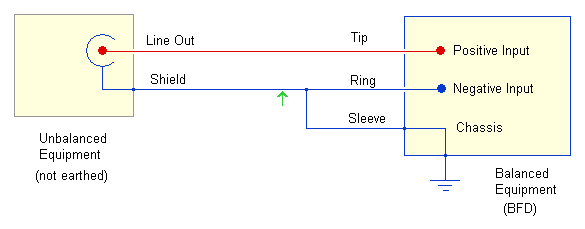
Hooking up the BFD
Had the source equipment been earthed, our previous logic would dictate that the shield be disconnected at the position indicated by the green arrow. The bridge between the ring and sleeve at the BFD end would still be needed.
Modification to the Open Shield approach
Since writing this section, it has been found that using a star-earth arrangement
between devices can lead to hum being introduced via induction and inter-modulation, as shown here...
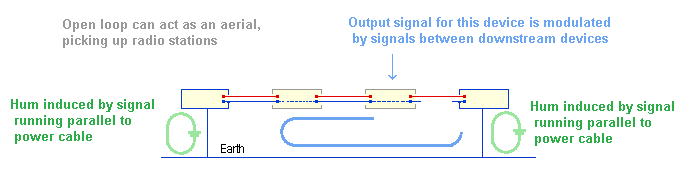
Problems with Open Shield
The authors of an article at Sound on Sound suggest bridging the shield gap with a 100ohm resistor and 100pf capacitor in parallel
This resistor allows the signal to follow the normal path via the shield, but cuts the level of hum. Hopefully to a level where it is not a problem
The capacitor is effectively open circuit for mains frequencies that result in hum, but conducts for the RF frequencies
Further reading
Here's an earth-loop article from the UK
For more information, including better drawings and debugging balanced systems, see Rane's excellent articles:
Sound System Interconnection
Grounding and Shielding Audio Devices
They are to be commended for making available articles from their technical library. Thank you Rane!