
SPL Meter
If you want to get the best out of your subwoofers and understand how to integrate them into your Home Theater system,
you must have an SPL meter. You just won't believe how useful they are!
Radio Shack (Tandy in Australia) make a cheap analog SPL meter, which is shown here, and the buzz amongst
the subwoofer fraternity is that the analog meter is better than the digital one
The only thing to watch is that it is not particularly linear at low frequencies, but it can be easily
modified or manually corrected ..
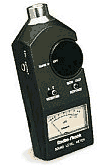
Radio Shack Sound Meter Corrections
This table comes courtesy of Dan Marx, who runs AudioInnovation, a site for fellow Audio Enthusiasts and Speaker builders. As well as his projects, he has some good info on speaker theory and a links section
After taking your measurements with the meter set to "C" weighting and "Slow" response, add the figure shown in this table
| Frequency | Correction | Frequency | Correction | |
| 10hz | +20dB | 500hz | -0.5dB | |
| 12.5hz | +16.5dB | 630hz | 0dB | |
| 16hz | +11.5dB | 800hz | 0 | |
| 20hz | +7.5dB | 1.0khz | 0 | |
| 26hz | +5dB | 1.25khz | 0 | |
| 31.5hz | +3dB | 1.6khz | -0.5dB | |
| 40hz | +2.5dB | 2.0khz | -1.5dB | |
| 50hz | +1.5dB | 2.5khz | -1.5dB | |
| 63hz | +1.5dB | 3.15khz | -1.5dB | |
| 80hz | +1.5dB | 4.0khz | -2dB | |
| 100hz | +2dB | 5.0khz | -2dB | |
| 125hz | +0.5dB | 6.3khz | -2dB | |
| 160hz | -0.5dB | 8.0khz | -2dB | |
| 200hz | -0.5dB | 10khz | -1dB | |
| 250hz | +0.5dB | 12.5khz | +0.5dB | |
| 315hz | -0.5dB | 16khz | 0 | |
| 400hz | 0dB | 20khz | +1dB |
Quick Tip:
An SPL meter will let you check that you have the phase switch at the best position. Find a passage that has some subwoofer action and check the level with the sub turned off. Now turn up the sub and check. Then change the phase switch and check for a third time. You may need to increase of decrease the volume of your sub to highlight the difference, but it should be easy to see which is the correct setting.
In the old days, measuring the frequency response of your subwoofer involved using a
tone generator and SPL meter
to measure a single frequency at a time. By increasing the frequency and repeating the measurement, a response could be built up.
With the advent of REW, that has all changed.
REW (Room Equaliser Wizard) is free software that generates a sweep frequency for your sub, and simultaneously measures
the response via a microphone attached to the soundcard. The response is then displayed on a graph.
There is more that REW can do - see the Room Eq Wizard study
page for more information and download links.
This relegates the SPL meter to doing spot checks, and to acting as a simple microphone for REW. Rather than re-invent the wheel, I'll refer you to this rather good article on Using REW to integrate subs and mains at AVForums.com
For those who might be confused about the bass management on their AV reciever, this block diagram might help
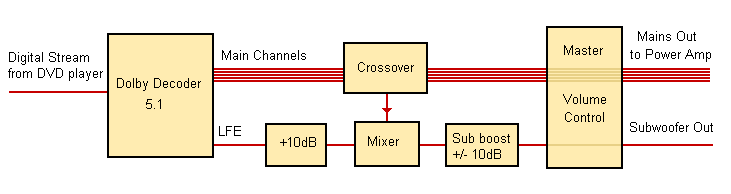
- The signal coming from the DVD player is decoded into the main and surround channels plus the LFE channel
- So the subwoofer can keep up, the Dolby spec adds 10dB to the LFE channel
- If you set any speakers to small, the Crossover will divert the bass from that channel to the mixer
- The individual speakers can be trimmed up or down. Only the +/-10dB trim is shown for the subwoofer out
A good overview of LFE, and the differences between Dolby surround and DTS is Brian Florian's article at hometheaterhifi.com
THX specifications
The THX Home Cinema certification calls for a flat power response from the subwoofer down to 20Hz with an SPL of at least 105dB
There's a great article on Dolby and DTS levels at Home Theater High Fidelity
There's an article on THX reference level and callibration in this blog at Nodef Home Theater
There's an article on THX Select and THX Ultra2 Certification General Questions at Audioholics
Cinema Reference Levels
Fronts 105dB at seating position in centre of cinema
Surrounds 102dB
Subs 115dB
Recommended headroom - add 6dB
normally calibrated with pink noise 20dB down ie 85dB fronts
Home Theatre THX Spec
Fronts 105
Subwoofer 105db at furthest seating position
From: carltonbale
THX certification for home theater was launched around 1998. Since then it's grown..
THX certification became THX Ultra (high power amplifiers required) and
THX Select was introduced (lower amplifier power requirements)
THX Ultra2 and THX Select2 replace the previous
Ultra/Select in 2005, adding more surround modes and better 7.1 support
THX Ultra2 Plus and THX Select2 Plus replace the previous
Ultra2/Select2 and add loudness compensation
Specs are anechoic, not room loaded. (Source
AVSForums)
THX Ultra - the original spec, now renamed
20hz 105dB less than 4% THD
For large sized home theatres up to 3000 cubic feet
THX Select - downgraded spec
For mid sized home theatres up to 2000 cubic feet
THX Ultra2
7.1 channel version for large sized home theatres up to 3000 cubic feet
20hz 105dB less than 4% THD
For more info, see the Official THX site